
Traction Therapy Review for Back and Neck Pain
A traction therapy review should answer one practical question first: will this treatment help you move, work, sleep, or exercise with less pain? For people in Fort Lauderdale dealing with a stiff neck after a long commute, sciatica that flares when sitting, or back pain that interrupts a workout, traction can be a useful part of care. It is not a magic fix, and it is not right for every condition. When it is selected carefully and combined with chiropractic care, exercise, and rehabilitation, it may help reduce pressure and restore more comfortable movement.
What Traction Therapy Actually Does
Traction therapy uses a controlled pulling force to gently lengthen and separate areas of the spine. Depending on the area being treated, the force may be applied to the neck, called cervical traction, or the lower back, called lumbar traction. A provider can deliver traction manually, with a specialized table, or with a mechanical device that uses measured force and timed cycles.
The goal is not to “pull a disc back into place.” That is an oversimplification. Instead, traction aims to create a temporary reduction in compressive forces around spinal joints, discs, and irritated nerve pathways. For some patients, that can ease muscle guarding, reduce the strain caused by certain positions, and make it easier to begin the movement and strengthening work that supports longer-term recovery.
A good treatment plan is based on your symptoms, exam findings, health history, and response to care. The setting, angle, amount of force, and duration should be adjusted rather than copied from someone else’s treatment.
Traction Therapy Review: When It May Help
Patients often consider traction after trying rest, stretching, or medication without enough relief. It may be considered for neck or low-back pain that includes symptoms such as stiffness, reduced range of motion, pain that travels into an arm or leg, or discomfort related to prolonged sitting and poor posture.
For example, lumbar traction may be appropriate for some people with radiating leg pain associated with nerve irritation or certain disc-related symptoms. Cervical traction may be helpful for selected patients whose neck pain travels into the shoulder, arm, or hand. Some people also find it helpful during recovery from a flare-up when ordinary movement feels guarded and painful.
The key phrase is “selected patients.” Research on spinal traction has produced mixed results because back and neck pain have many causes, and studies often examine different devices, treatment schedules, and patient groups. That does not mean traction has no value. It means it should be used as one tool within an individualized plan, not presented as a universal answer for every painful back or neck.
Traction tends to make the most sense when the examination suggests that unloading the spine may reduce symptoms and when progress is measured from visit to visit. If a patient feels no meaningful change after an appropriate trial, the plan should be reassessed.
What a Session Can Feel Like
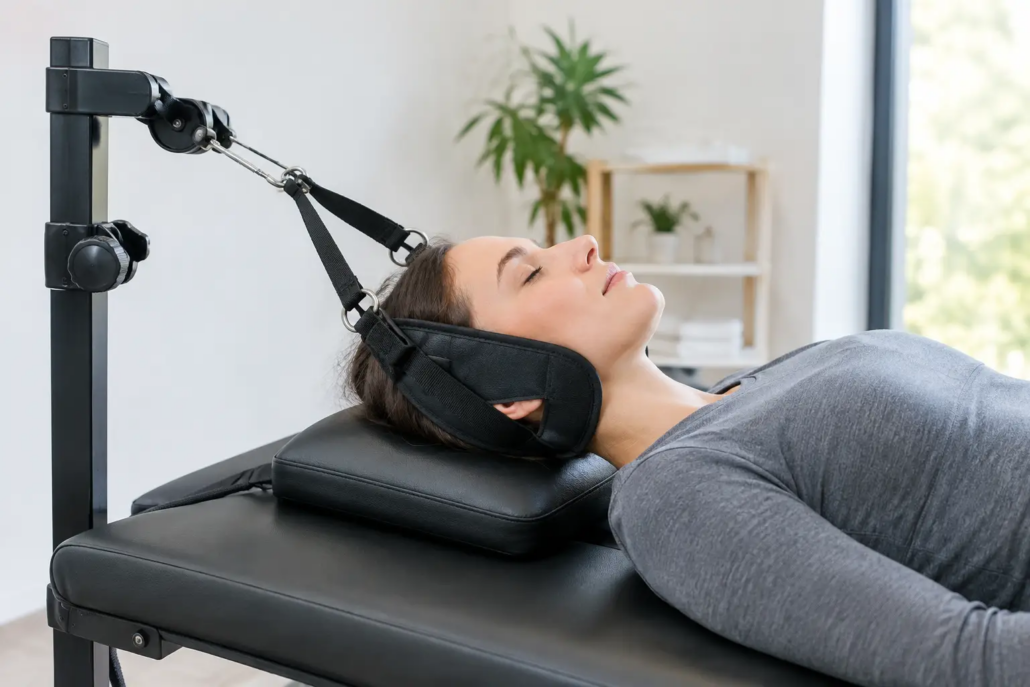
A traction session should feel controlled and tolerable, not aggressive. During cervical traction, you may lie comfortably while a harness supports the head and applies a gentle pull to the neck. During lumbar traction, straps are typically placed around the torso and pelvis while a table or device provides gradual tension.
Many patients describe a feeling of stretch, decompression, or relief from pressure. Some feel relaxed afterward, while others notice mild temporary soreness as tight tissues begin to move differently. The provider should check in during treatment, especially early in care, and adjust the settings if symptoms increase.
A session is commonly paired with other therapies based on your needs. Soft tissue treatment or massage may help calm protective muscle tension. Chiropractic adjustments may improve joint mobility when appropriate. Corrective exercise and rehabilitation help train the body to maintain better movement between appointments. Heat or cold therapy may also be used for comfort during an acute flare-up.
This integrated approach matters because traction may create a window of reduced symptoms, but lasting improvement usually requires addressing the habits and movement patterns that contributed to the problem. Hours at a desk, repetitive lifting, weak supporting muscles, an auto accident injury, and poor recovery after activity can all influence whether pain keeps returning.
Benefits Worth Considering
The strongest benefit of traction is that it is non-surgical and drug-free. For patients who want to avoid relying solely on pain medication or who are not ready to consider invasive procedures, it can be a conservative option worth discussing.
It may also be easier to tolerate than forceful treatment during a painful flare-up. When the right amount of traction decreases symptoms, patients may be able to walk more comfortably, turn their head more freely, or participate more effectively in rehabilitation exercises.
Another advantage is precision. Mechanical traction allows the provider to control the direction, force, and timing of the pull. That can be useful when symptoms change with certain positions or when a patient needs a gentle, repeatable approach.
Still, the benefit depends on the diagnosis. Muscle strain, arthritis, posture-related tension, disc irritation, and nerve symptoms can overlap, but they do not always respond to the same treatment. A personalized exam is more valuable than choosing traction because a friend, online review, or advertisement said it worked for them.
Limitations and Safety Concerns
An honest review of traction therapy needs to include its limits. It cannot correct every cause of pain, and it should not delay appropriate medical evaluation. Pain relief from traction may be temporary if it is not followed by steps that improve strength, mobility, posture, and daily movement habits.
Traction may be inappropriate or require medical clearance for people with certain conditions, including spinal instability, fractures, severe osteoporosis, active cancer involving the spine, some inflammatory disorders, or signs of serious neurological compromise. Pregnancy, recent surgery, and some vascular conditions may also change what treatment is appropriate.
Seek urgent medical attention rather than routine traction care if you have new loss of bowel or bladder control, numbness in the groin area, rapidly worsening weakness, unexplained fever, major trauma, or severe pain that does not improve with rest. These symptoms need prompt medical assessment.
For less urgent concerns, the right provider will ask about your health history, examine your posture and movement, and explain why traction is or is not being recommended. You should not feel pressured into a preset package without a clear clinical reason and a way to measure progress.
How to Judge Whether It Is Working
Do not judge traction by one session alone, but do not continue indefinitely without evidence of improvement. Early positive signs may include less radiating pain, easier movement, better sleep, fewer symptom flare-ups, or increased ability to perform rehabilitation exercises.
Progress should also show up in daily life. Can you sit through a work meeting with less discomfort? Can you look over your shoulder while driving? Can you walk farther, return to the gym safely, or pick up your child with more confidence? Those functional changes matter more than a temporary feeling of being stretched.
At HealthPoint Chiropractic, traction is considered alongside chiropractic adjustments, soft tissue care, massage, and corrective rehabilitation so treatment can match the person, not just the label on their pain. A patient with recent whiplash may need a different plan than a runner with low-back stiffness or an office worker with recurring neck tension.
A Practical Next Step
If back or neck pain is affecting your routine, ask for an evaluation that explains the likely source of your symptoms and the role traction could play. The best care plan should feel understandable, comfortable, and adaptable as your body responds. Relief matters, but the more useful goal is getting back to the movements and moments pain has been taking away from you.





